Periods and bleeding
How abnormal uterine bleeding is diagnosed
After you report abnormal bleeding, a doctor starts with questions about the bleeding, your health and your medicines, then usually an examination, a pregnancy test and a full blood count. Depending on your age, the pattern and your risk factors, the next step is a transvaginal ultrasound or a look inside the womb with a thin camera (hysteroscopy), sometimes with a small sample of the womb lining (endometrial biopsy).
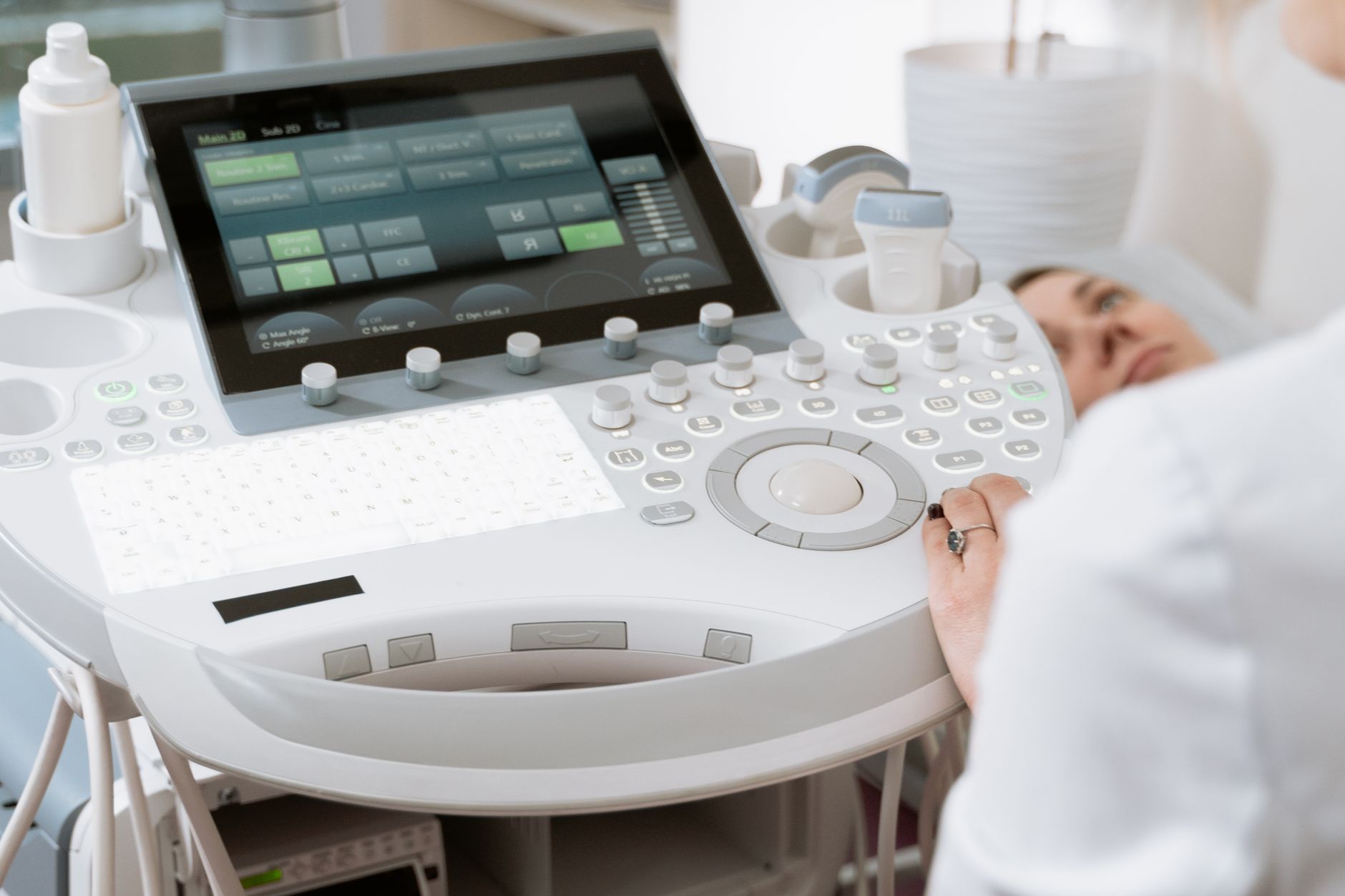
Every page about bleeding in perimenopause, ours included, ends by telling you to see a doctor. This one picks up where they stop. It follows the UK's NICE guideline on heavy menstrual bleeding (NG88) and the American College of Obstetricians and Gynecologists' guide to abnormal uterine bleeding, and it notes where the two differ. Treatment is your doctor's call, so it stays out of this article.
The first appointment: questions about the bleeding
The first step is talking. NICE tells doctors to ask about the nature of the bleeding, about symptoms that point to a cause (repeated mid-cycle bleeding, pelvic pain, a feeling of pressure), about how much the bleeding affects your life, and about anything that changes the options, such as other health conditions or treatment you have already tried. ACOG adds your pregnancy history, your contraception, every medicine you take, including ones bought over the counter, and your family's health history.
ACOG also asks patients to keep track of the dates, length and type of bleeding for several weeks before the visit, rated light, medium, heavy or spotting. Those notes do a lot of the work. If you have not started yet, our printable symptom diary and appointment checklist has a column for flow, and the PBAC blood loss scorer turns pads, tampons and clots into one number a doctor recognises.
Examination and blood tests
A physical examination, usually including a pelvic exam, comes next. NICE allows one exception: if the only problem is heavy periods, with no other symptoms, a doctor may suggest treatment without examining you first. Before any scan or camera test, though, NICE expects an examination.
The blood tests are fewer than many people expect:
- a full blood count, which NICE says every woman with heavy periods should have, to check for anaemia (ACOG adds that it can point to infection)
- a pregnancy test, because pregnancy is still possible in perimenopause and miscarriage and ectopic pregnancy are on ACOG's list of causes
- tests for sexually transmitted infections, which ACOG lists when infection is possible
- tests for a clotting disorder such as von Willebrand disease, which NICE reserves for women whose periods have been heavy since they started and who have a personal or family history of bleeding problems
Two tests are usually missing, and that surprises people. NICE tells doctors not to test female hormones in women with heavy periods, and not to test thyroid hormones unless there are other signs of thyroid disease. Hormone levels swing too much in perimenopause to explain a bleed, a point covered in is there a test for perimenopause? If you do have thyroid symptoms, say so: perimenopause or thyroid? lists the ones that overlap.
Transvaginal ultrasound for heavy periods
An ultrasound uses sound waves to make a picture of the womb and ovaries. A transvaginal scan puts a slim probe a short way into the vagina, which gets closer to the womb than a scan over the tummy. NICE prefers it, over a tummy scan or MRI, when heavy periods come with significant period pain or the womb feels bulky and tender on examination, which are both signs of adenomyosis. It also offers a pelvic ultrasound when the womb can be felt through the tummy, when a mass is suspected, or when an examination was difficult or unclear, all of which raise the question of larger fibroids.
A scan is good at showing the muscle wall of the womb and the ovaries. NICE notes it is weaker at finding problems inside the cavity, such as polyps or small fibroids bulging into it. That is where the camera test comes in.
Hysteroscopy for bleeding
In a hysteroscopy, a thin tube with a small camera passes through the vagina and cervix into the womb, and salt water is run in so the lining can be seen on a screen. The NHS hysteroscopy page says it usually takes 10 to 15 minutes, longer if a sample is taken or a polyp or fibroid is removed at the same time. NICE wants clinics to work this way, finding and treating in one visit where they can.
NICE offers an outpatient hysteroscopy first when the history suggests something inside the womb: persistent intermenstrual bleeding, or risk factors for changes in the lining (listed in the next section). If you decline it as an outpatient, it can be done under a general or regional anaesthetic.
Pain is the part people worry about, and the NHS does not play it down. It can feel like period pain, and for many people it is very painful. The NHS suggests telling the clinic beforehand if periods make you faint, if past smears or internal exams have hurt, or if you have experienced sexual violence, and asking about pain relief options before the day. You can bring someone with you and ask to stop at any time. Spotting for up to a week afterwards is normal, and the NHS tells you to contact the clinic urgently if bleeding gets worse, pain is not eased by your usual painkillers, or you get a fever or smelly discharge.
Endometrial biopsy in perimenopause
An endometrial biopsy removes a small piece of the womb lining so a lab can look at it under a microscope. MedlinePlus lists heavy, prolonged or irregular bleeding, a thickened lining seen on ultrasound and bleeding on hormone therapy among the reasons for it. It says cramping is usually mild, severe for some women, and short either way. An abnormal result can point to polyps, fibroids, infection, a hormone imbalance, or precancer (hyperplasia) or cancer of the lining.
NICE suggests a biopsy for women at higher risk of changes in the lining:
- bleeding between periods, or irregular bleeding, that persists
- infrequent but heavy periods in someone who is obese or has polycystic ovary syndrome
- taking tamoxifen
- heavy bleeding that treatment has not improved
Here the UK and US differ. NICE says the sample should be taken during a hysteroscopy and advises against a "blind" biopsy for heavy periods. In the US, ACOG lists endometrial biopsy among the tests your doctor may choose from based on your symptoms and age, without tying it to a hysteroscopy. Both bodies share the reason for doing it: ACOG names perimenopause as one of the times when cycles without ovulation can let the lining grow too thick, and a sample is the way to see whether it has.
Other tests you might hear about
ACOG lists three more. In sonohysterography, fluid is run into the womb during an ultrasound to outline the cavity. MRI and CT give detailed pictures of the pelvic organs. NICE keeps saline sonography and MRI out of the first round of tests, and says a D&C (dilatation and curettage) should not be used on its own to find the cause. An MRI is more likely later, for example to map fibroids before a procedure.
What the tests are looking for
Gynaecologists sort the causes of abnormal bleeding with a system the International Federation of Gynecology and Obstetrics published in 2011 and revised in 2018, known by its initials, PALM-COEIN. The first four letters are the causes a scan, a camera or a lab can see: polyps, adenomyosis, leiomyoma (fibroids) and malignancy or hyperplasia. The last five are the ones that leave no visible trace in the womb: coagulopathy (a clotting disorder), ovulatory problems, causes in the endometrium (the lining), iatrogenic causes from medicines or devices such as hormonal contraception, blood thinners or a copper coil, and causes not yet classified.
That split explains the order of the tests. The scans and the biopsy look for the visible causes. Irregular ovulation, the usual driver of bleeding changes in perimenopause, does not show on a scan, so it becomes the working explanation once nothing else turns up. ACOG adds that sometimes there is more than one cause.
Endometriosis and adenomyosis
Adenomyosis, where the lining grows into the muscle wall, is what NICE picks a transvaginal scan to find. Endometriosis is harder. The NHS endometriosis page says it can take a long time to diagnose, that an ultrasound or MRI may be used, and that a laparoscopy, where a camera goes in through a small cut in the tummy, is the test that can confirm it. NICE reminds doctors that pain with heavy bleeding may come from endometriosis even when adenomyosis is the first suspect. Period pain that is new or worse is covered in period pain in perimenopause.
When not to wait for the tests
ACOG's emergency rule applies before any of this: if you are soaking a pad or tampon every hour for more than 2 hours in a row and you also have chest pain, breathlessness, or feel lightheaded or dizzy, get emergency care. Bleeding after 12 months without a period follows a faster route of its own, set out in bleeding after menopause. If you are not sure whether what you have counts as abnormal at all, the bleeding checker sorts it, and heavy periods and blood clots and spotting between periods cover the two commonest patterns.
My take
I'd start with the record, not the scan: two or three cycles written down before the first appointment. Then I'd ask the doctor one direct question: which of the visible causes are you trying to rule out, and which test does that? The answer tells you whether a scan or a hysteroscopy comes next and why. If a hysteroscopy is booked, I'd phone the clinic a few days ahead to ask what pain relief they offer, so it is settled before you arrive. I'd take clear results as a real answer too. They make irregular ovulation the likeliest explanation, and the next conversation can be about how much the bleeding affects your life.
Related reading
Everything on cycle changes is collected under periods and bleeding. If periods are going on for weeks rather than days, bleeding for weeks in perimenopause explains what thickening of the lining means.
Frequently asked questions
Does a hysteroscopy hurt?
Will I definitely need an endometrial biopsy?
Can a blood test show whether the bleeding is just perimenopause?
Written by
Last checked 2026-11-05
Comments
No comments yet. Questions and your own experience are welcome.
Thank you. Your comment will appear once it has been reviewed.